


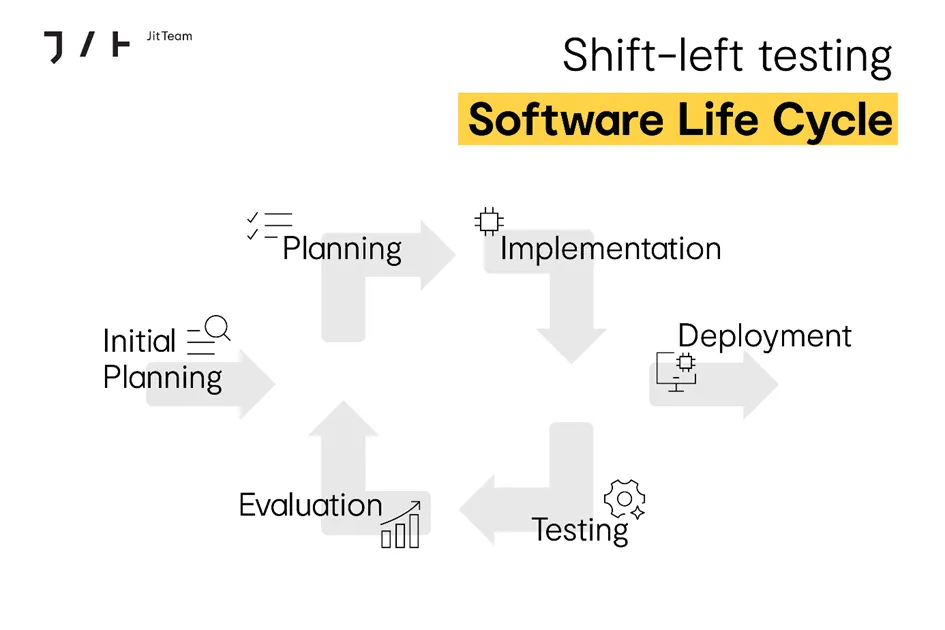
Shift-left testing is not a new approach to testing, but it is gaining popularity every year and is being used more and more in projects and teams. It assumes the testing processes are performed as early as possible in the software development lifecycle.
Traditional models of quality control (shift-right)
In traditional quality control models, testing was performed at the end of the software development process, and moved to the right in the context of the entire software development and lifecycle. This led to the fact that tesing took place at a later stage of the design process. Initially, in the traditional shift-right method, the focus was on defining and creating software without much quality or testing, and only at a later stage was there verification to check what was produced. The shift-right approach, however, generates many difficulties in the project and many problems with the product.
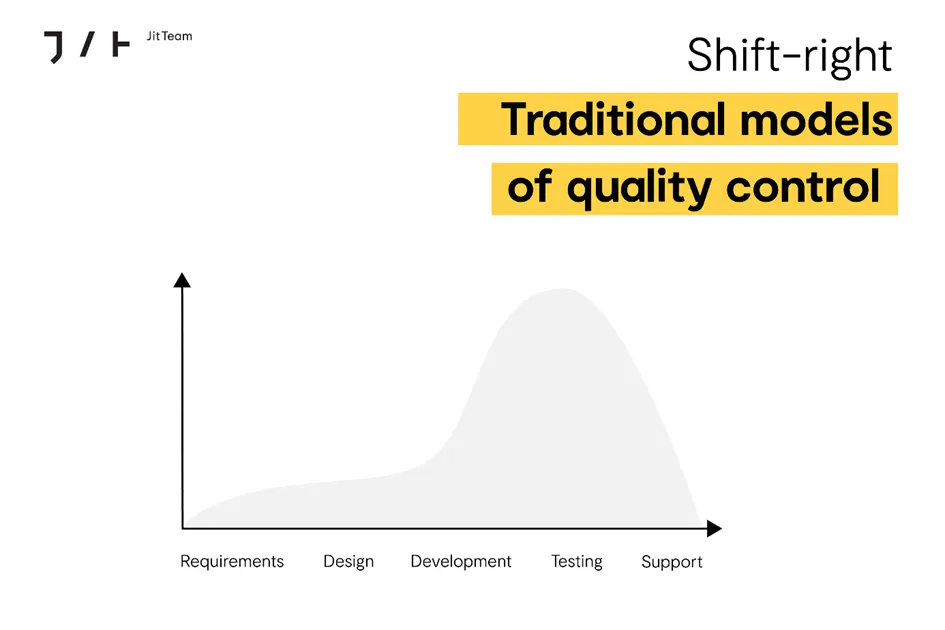
In the shift-right testing approach, one can identify a number of problems, such as:
- Little involvement of the testing team at the beginning of the project and thus less or no quality control at the beginning.
- Defects in requirements or a project description; features are found late, often too late, i.e. when they have already been implemented.
- Defect elimination, i.e. defect identification, debugging, correction, as well as checking with regression tests is more difficult.
- White-box testing, which is based on code coverage with tests, becomes practically impossible.
- Late detection of defects results in little time left for their improvement, because either the version is already implemented or it is just before the implementation. Therefore, there is no time to repair all the defects, so the implementation needs to be postponed e.g. until the next version of the application.
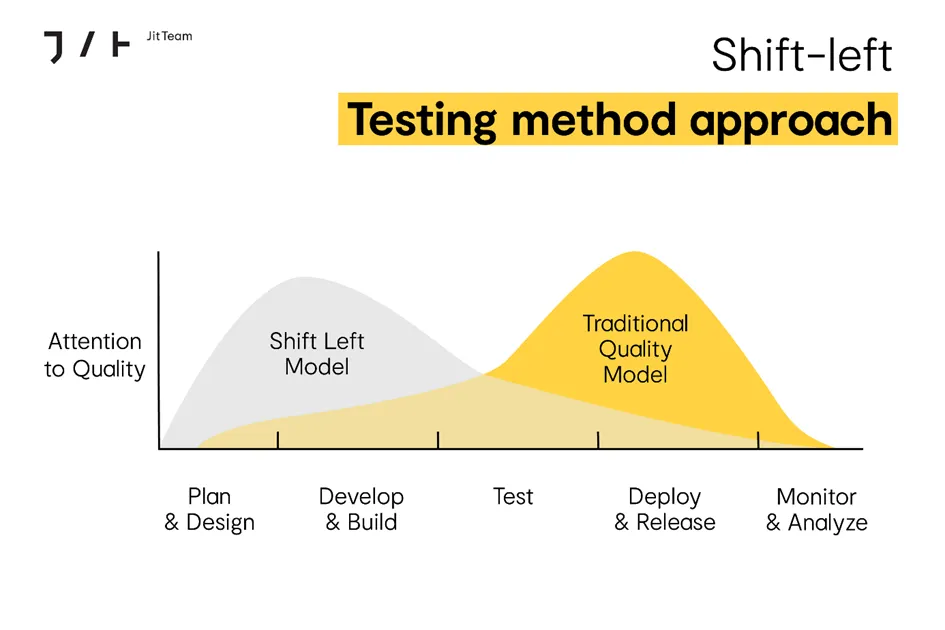
Shift-left testing method approach
The shift-left approach to testing requires that the overall effort in quality control starts as early as possible in the software lifecycle. Testers are engaged in earlier stages of the project lifecycle, such as requirements analysis, architecture design, and coding. The goal of this approach is to detect and resolve quality issues early in the process, before they are introduced into the system.
Best practices for shift-left testing in agile development
The shift-left method applies to moving testing activities and actions closer to the beginning of the software development lifecycle, allows faster feedback and reduces the amount of time and energy deposits put into fixing bugs and anomalies in the system. Below are some examples of best practices to apply in your Agile project. By implementing them, agile teams can achieve better collaboration, faster feedback, and higher-quality software products through shift-left testing.The basic conflict carrier is — change, they change the state of application based on so-called Feature Toggles. This simple object tells the developer or Product Owner that they can switch on or switch off part of the functionality of their application, for e.g. A/B testing.
- Early involvement – test actions should be started as early as possible in the development process. Testers should already be involved at the stage of describing and establishing requirements to get the best understanding of the project, its assumptions, and goals, as well as the customer’s expectations and end-user needs.
- Collaboration and communication – close collaboration and advanced, clear communication within the Agile team are crucial. Collaboration must involve the entire team, including developers and testers so that they understand each other’s needs and communicate expectations. Regular team meetings such as daily or retrospectives help maintain team communication and information flow as well as clarify the team’s common goal.
- TDD – encourage the practice of Test-Driven Development, where developers prepare and write test cases before writing the real code. This approach of shift-left testing helps define predicted behavior and expectations early on, resulting in more reliable and testable code.
- Shift-left security testing – pay attention to integrating security testing early in the development process. Security code reviews, static code analysis, and security-targeted testing will help identify any security vulnerabilities and proactively address them.
- Automation tests – investing in automated testing at the early stages of software development results in earlier defect detection and more efficient testing at a lower cost.
- Performance testing – introduce performance testing early in the software lifecycle to identify bottlenecks and scalability issues. It will equip you with the knowledge and control over the application’s performance. Thanks to that you will be able to optimize it and make it meet specific requirements.
- Exploratory testing – it is important to do exploratory testing from the beginning of application development to learn about the application from the user’s perspective. In doing so, testers can find potential end-user usability issues that automated testing may have missed.
- Test environments and test data it is important to have a test environment that is as similar to the customer’s environment as possible in order to realistically test applications. You also need to make sure that there is adequate data that is sufficient and representative to replicate realistic scenarios.
- Continuous learning and improvement – continuous development in testing and test modification is important. In addition, retrospective meetings are important to discuss important issues in the software development cycle and to consider process improvements together for even more efficient testing.
Benefits of using the shift-left method in testing software
There are many advantages of shift-left-based testing in various aspects of software. Bugs are found faster, fixes can be implemented more efficiently in terms of time and resources. On top of that, the lessons that the team learns from previously detected bugs will be used in subsequent features, and you may be able to avoid duplicating bugs or quickly change your approach to the one that is more beneficial to the project. Whatever project management methodology or release cadence your team has, you may notice faster feedback from verification from shift-left testing.
- Financial cost saving – detecting bugs early on is customarily cheaper because it is not as time-consuming to fix them, the number of places to improve is smaller, they are not as complex and elaborate, bugs do not accumulate because they are discovered early, and can be fixed quickly and continue working on the software.
- Resilient architecture – more accessible software is usually easier for the user to operate, and thus testable software is easier to maintain. Early testing leads to better separation of problems and bugs, and thus a more consistent design architecture.
- Developer wellbeing – automated tests that are done correctly lead to developers’ well-being and peace of mind in trusting the software. Finding defects quickly equals less panic and fewer unexpected problems in software. Fixing bugs that are found quickly is easier and more pleasant for developers, making them feel more content with the project.
- Higher total quality – increasing the overall quality of the product is important to the customer, and customer satisfaction is key to the project. Shift left allows you to reduce and eliminate unwanted incidents, and also if they do occur, reduce their impact by developing a quick workaround. The final state of the software will benefit from this.
Summary
Shift-left testing is an approach in which testing is done early on in the software development lifecycle. The concept is not new, but it is being increasingly applied in projects. It allows you to find bugs faster, at a lower cost, and fix software earlier to meet the requirements. In addition, it engages the testing team at the beginning of software development, which gives them the opportunity to become familiar with the application and make their suggestions and proposals. Thanks to that, every tester can feel an integral and important part of the team from the very beginning.